U.S. gas storage rises 80 Bcf, remaining 3.8% below the year-earlier level
EIA's October 29 release estimates Lower 48 working gas in underground storage at 3,724 Bcf for the week ending October 23, up 80 Bcf from the previous week.
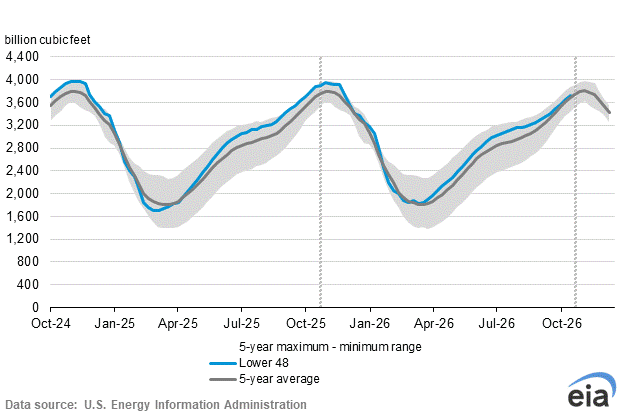
The story explained
EIA’s October 29 release estimates Lower 48 working gas in underground storage at 3,724 Bcf for the week ending October 23, up 80 Bcf from the previous week. Bcf denotes billion cubic feet.
Stocks were 147 Bcf, or 3.8%, below the year-earlier level of 3,871 Bcf. They were 38 Bcf, or 1.0%, above the 2021–2025 average of 3,686 Bcf and remained within the five-year historical range.
South Central stocks increased 43 Bcf, the Midwest 23 Bcf, the East 13 Bcf and the Mountain region 1 Bcf; Pacific stocks were unchanged. EIA cautions that independent rounding can prevent components from summing exactly to totals.
The figures are survey estimates of inventory and weekly change, not gas prices, consumption or equipment orders. The total-stock coefficient of variation is 0.4%, and the net-change standard error is 1.1 Bcf. The next release is scheduled for November 5.
Why it matters
Editorial analysis: Inventory and regional differences indicate storage operating conditions. Equipment and maintenance demand require separate procurement evidence.
Relevant toGas-storage, compression, valve and maintenance businesses
What to watch next
Monitor revisions, regional injection and withdrawal changes, and winter operating plans.
These are research prompts, not announced tenders or confirmed subsequent developments.
U.S. Energy Information Administration
Weekly Natural Gas Storage Report — week ending October 23, 2026; released October 29
This is an independently written summary and analysis, not an official translation. Project plans and status may change.